Do Crows Remember People for Generations -- and Is It Legal to Own One

You've probably had a crow stare at you a little too long. Maybe you shooed one away, and it followed you down the street. These birds aren't being dramatic. They may actually be memorizing your face, and filing it away for years to come.
Crows are among the most cognitively advanced animals on the planet. The science backs this up, and some of the findings are genuinely hard to believe.


Crows Really Do Remember Your Face
In 2006, Dr. John Marzluff and his team at the University of Washington ran one of the most memorable bird studies ever conducted. Researchers wore a "dangerous" caveman mask while trapping and banding wild crows. A separate "neutral" mask, a Dick Cheney mask, was worn by researchers who simply walked past without interacting with the birds.
The crows consistently scolded and dive-bombed anyone wearing the caveman mask, while ignoring the neutral one. That part is surprising enough. But here is what made the study extraordinary: the behavior continued for 17 years.
Even as the original birds aged and died, younger crows who had never been trapped continued mobbing the dangerous mask. They learned it from their parents, who learned it from their parents. The number of crows reacting to the mask grew from the original 7 trapped birds to over 40 within a few years, spreading through the local population like a warning passed down through generations.
PET scans of crow brains confirmed the mechanism. When a crow sees a face it associates with danger, the amygdala lights up, the same region humans use for fear and emotional memory. These are not random responses. Crows are running the same cognitive software as us in a very different body.
How They Pass the Memory Down
Crows do not inherit memories genetically. Instead, they learn through observation. When a parent crow spots a threatening face, it starts mobbing: scolding loudly, dive-bombing, circling. Fledglings watch this behavior and make the connection. That face equals danger.
This is called vertical social learning, and crows are extraordinarily good at it. The knowledge moves both downward (parent to offspring) and sideways (crow to crow in the same flock). So if you upset one crow in a neighborhood, you may eventually have a problem with the whole local population, for years after the original incident.
The inverse is also true. Crows remember kindness. Brain scans showed that crows who were consistently fed by a specific person displayed activation in regions tied to motivation and reward when they saw that person's face again. If you feed a crow regularly, you are building a relationship stored in its memory for the long term.
A Few More Examples of Crow Intelligence
Memory is only one piece of the puzzle. Crows demonstrate problem-solving abilities that have surprised researchers repeatedly.

A captive crow named Betty spontaneously bent a straight wire into a hook to retrieve a food bucket from a tube. She had never seen this done before.
New Caledonian crows in the wild craft hooked tools from twigs following a consistent three-step sequence: selecting a branch fork, trimming it, then sculpting the hook with their bill.
In lab settings, crows have completed puzzles requiring up to eight sequential steps, pulling a string to get a stick, using that stick to get a longer stick, then using the long stick to extract food from a deep container.
Crows have demonstrated understanding of water displacement by dropping heavy stones into a water tube to raise the level and reach floating food. They prefer solid stones over hollow ones, showing they understand physical properties, not just trial and error.
For context, great apes also use tools and reason causally. Crows have evolved these same abilities through an entirely separate branch of evolution. They are not "bird-brained" in the way that phrase implies. They simply run a different kind of brain.
So Can You Actually Own a Crow?
This is where many people get surprised. In the United States, it is federally illegal to own a native crow as a pet. The Migratory Bird Treaty Act of 1918 protects American Crows and most other native corvids. Possessing one without authorization can result in fines up to $15,000 and potential jail time. Canada has a similar prohibition under the Migratory Birds Convention Act.
In the United Kingdom, it is legal to keep a crow only if you can prove the bird was legally obtained, meaning captive-bred from a licensed breeder or a rescued bird that wildlife authorities have certified as unfit for release. Grabbing a healthy crow from the wild remains illegal. Australia's rules vary by state, though native crows are generally protected.
There is one notable exception in the US: non-native species. Birds like the Pied Crow, native to Africa, are not covered by the Migratory Bird Treaty Act. They can be legally owned at the federal level, though individual states may still restrict them. They also require specialized care, significant space, and a long-term commitment since corvids live for decades in captivity.
Who Are All These People With Crows?
If you have seen videos online of people with surprisingly friendly crows perched on their shoulders, there are a few explanations.
Licensed wildlife rehabilitators are the most common legitimate answer. They are legally permitted to temporarily house injured or orphaned native crows with the goal of releasing them back into the wild. During rehabilitation, some birds become accustomed to human contact, particularly if they were raised from young chicks. These birds are not pets. Rehabilitators work under strict federal and state permits, and the care is capped at around 180 days before release.
Crows that cannot be released due to permanent injury may become educational ambassadors at licensed wildlife centers. Again, not pets, but birds kept under permit for public education programs.
Some people in the videos are simply feeding wild crows regularly, building a voluntary relationship where the bird chooses to return. These crows remain wild. They come and go freely. That is legal, and it is actually one of the most interesting ways to observe crow behavior up close.
Some accounts show birds that were raised illegally from chicks and imprinted on humans. These birds often cannot survive in the wild and are in a difficult legal and ethical grey zone. The people keeping them are not always aware of the law, or choose to ignore it.
Should You Try to Build a Relationship With a Wild Crow?
Yes, and it requires no law-breaking. Crows respond to consistent feeding, calm behavior, and predictable routines. Unsalted peanuts, eggs, and meat scraps are popular choices. Leave food in the same spot each day, move slowly, and avoid direct sustained eye contact at first.
Given everything we know about crow memory, the relationship you build is real to them. They will recognize your face, associate it with positive experiences, and over time may bring you gifts such as shiny objects, buttons, or small stones. This behavior has been documented repeatedly by people who feed crows regularly.
The flip side: be consistent and be kind. If you ever upset a crow in your neighborhood, there is a real chance it tells others about it. Given the research, that social note may stick around longer than you expect.
Crows are not pets, legally or practically. But if you treat them with respect, you might find they treat you the same way, and remember that you did, for a very long time.
If You Want to Go Deeper
Whether you want to start feeding your local crows or learn more about what is actually going on inside their heads, here are a few products worth having.
Start a Crow Feeding Routine

Unsalted Peanuts in the Shell
The single best food for building crow trust. Crows love the foraging challenge of cracking shells, and they will bury extras for later. Buy in bulk for best value.

Open Platform Bird Feeder
Crows are too large for tube feeders. A wide, flat platform tray gives them room to land, eat, and feel comfortable. Look for one with drainage holes so food stays dry.

Smart Bird Feeder with Camera
AI-powered feeders like the Bird Buddy or Netvue Birdfy identify and photograph every visitor. A great way to track which individual crows are returning to your yard.
Books Worth Reading
These are the most respected books on crow and corvid intelligence, written by the researchers who ran the studies referenced in this article.

Gifts of the Crow
John Marzluff and Tony Angell
Written by the same Dr. Marzluff behind the mask study. This book explains how crows perceive, feel, and think, and why their behavior overlaps so closely with our own.
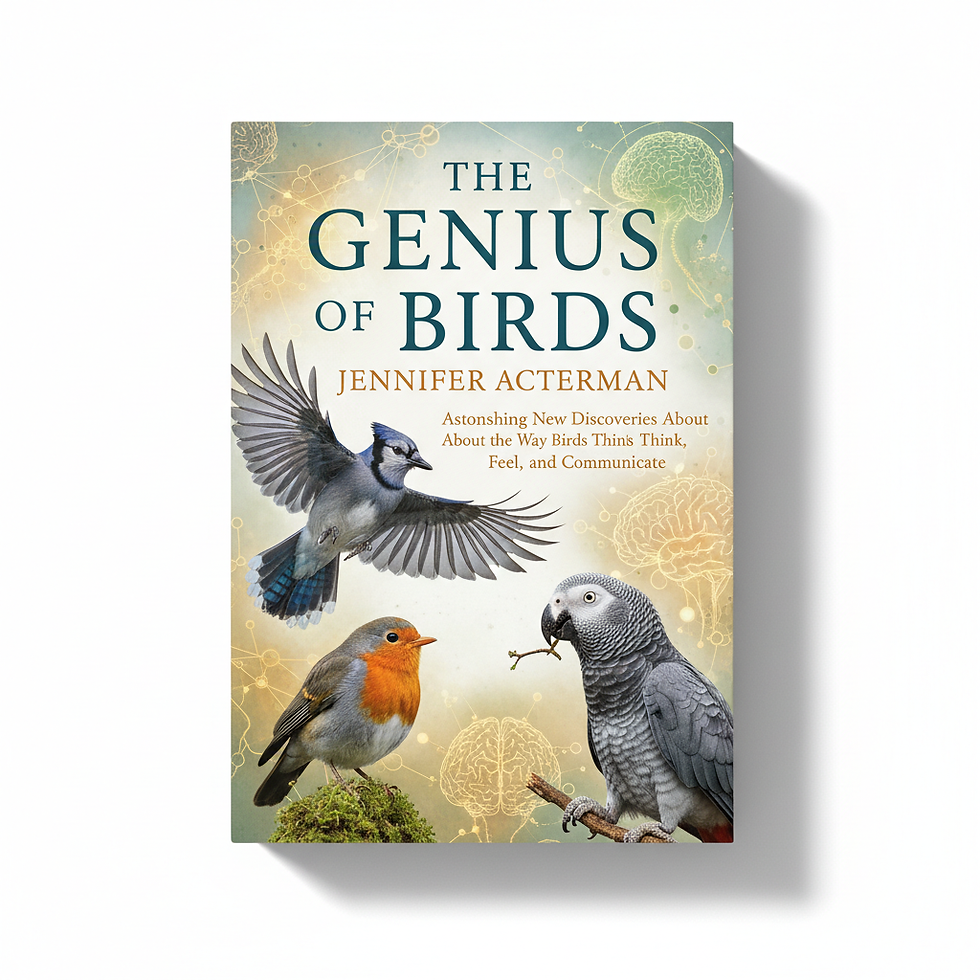
The Genius of Birds
Jennifer Ackerman
A broader look at avian intelligence, with a strong focus on crows and New Caledonian corvids. Accessible, well-researched, and one of the best entry points into the science of bird cognition.
As an Amazon Associate, this site earns from qualifying purchases.

Comments