Danios Tetras and Rasboras Do They Get Along Minimum Tank Size Care Guide


Three of the most popular freshwater fish in the hobby, Danios, Tetras, and Rasboras, share more in common than their beginner-friendly reputations. They are peaceful, schooling fish that thrive in groups, tolerate similar water conditions, and bring a stunning mix of color and movement to any community tank. But knowing they are "compatible" is just the start. This guide covers everything you need to set up a thriving tank with all three.
Do Danios, Tetras, and Rasboras Get Along?
Yes, and they tend to do very well together. The key reason is that each group naturally occupies a different level of the water column:
Danios are fast, active surface swimmers. They zip along the top of the tank in tight formation.
Tetras cruise the mid-to-lower levels, often hovering near plants or driftwood.
Rasboras prefer the mid-to-upper zone, making them a natural bridge between the other two.
This natural layering means the three groups rarely compete for the same space, which reduces stress and territorial behavior. They also share similar water parameter needs, which makes managing the tank significantly easier.
One thing to watch: Danios are energetic and can sometimes startle or stress slower, more timid fish. Keeping them in large enough groups (more on that below) channels their energy inward toward their own school, reducing the chance they bother tank mates.
Temperament: Docile or Aggressive?
All three groups are considered peaceful community fish, but there are nuances worth knowing.
Danios are boisterous and curious, not aggressive. They may chase other fish briefly, but it rarely results in damage. The exception is when kept in groups that are too small, which can lead to fin nipping.
Tetras are generally calm, but some species like Serpae Tetras are known fin nippers if kept in groups under six. Neon, Cardinal, Ember, and Rummy Nose Tetras are all reliably peaceful.
Rasboras are among the most docile fish in the hobby. Harlequin Rasboras and Chili Rasboras rarely show aggression toward anyone.
The takeaway: stick to peaceful species within each group, keep school sizes appropriate, and you will have a genuinely harmonious tank.
What Makes Each Fish Unique?

Danios
Danios are built for speed. Their torpedo-shaped bodies and horizontal stripe patterns (in species like Zebra Danios) make them one of the most visually striking surface swimmers. Zebra Danios are also a cornerstone of biomedical research: they share around 70% of their genes with humans, can regenerate their heart and fins, and have fully transparent embryos. Outside the lab, Celestial Pearl Danios offer a completely different look, with deep blue bodies covered in pearl-like spots and vivid orange fins. Danios are also uniquely cold-tolerant. Zebra Danios can live comfortably in unheated tanks as low as 64°F, making them one of the few tropical fish that work in cooler setups.

Tetras
Tetras belong to the Characidae family and carry a few biological surprises. Most species have a small, fleshy fin between their dorsal and tail fins called an adipose fin, whose exact purpose is still debated by scientists. They also have a chain of small bones connecting their swim bladder to their inner ear, giving them unusually sharp hearing for a small fish. The famous "neon glow" of Neon and Cardinal Tetras is not bioluminescence. It comes from crystalline plates called iridophores that reflect light, which is why they remain vivid even in dim, blackwater conditions. This is a species that genuinely looks better in a darker, more natural setup.
Rasboras
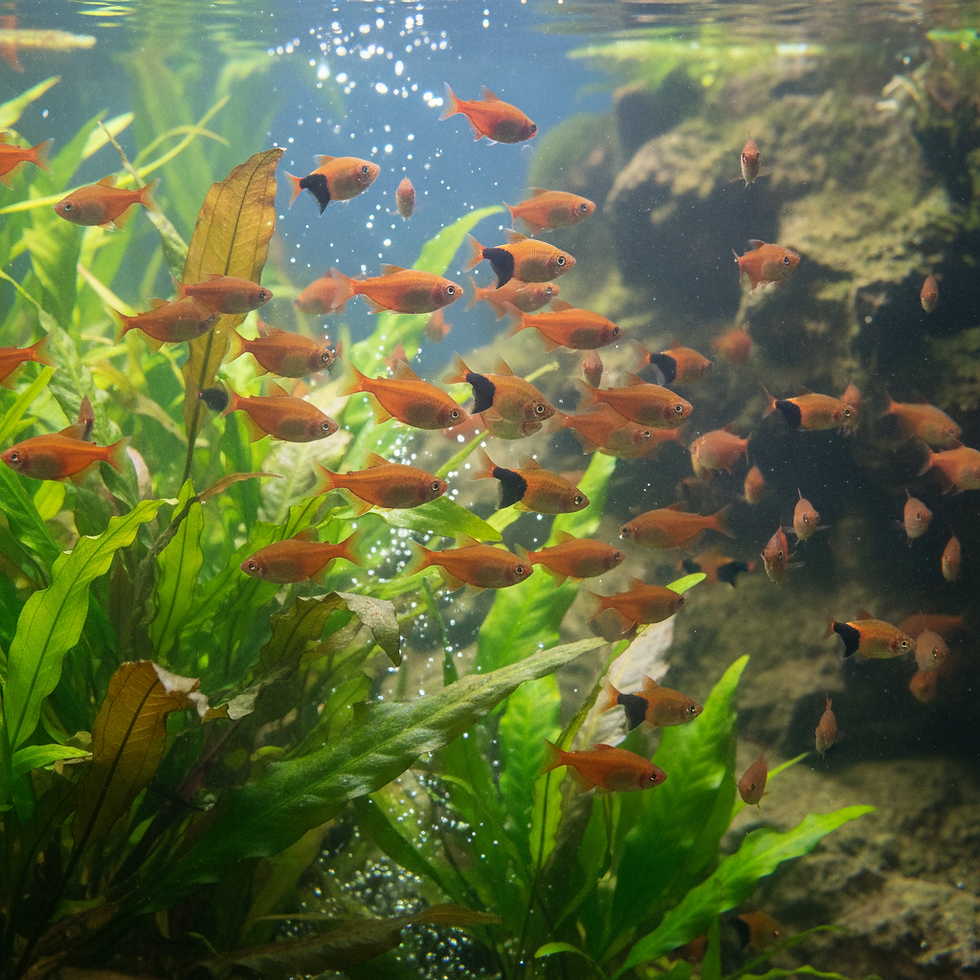
Rasboras contain some of the smallest vertebrates on Earth. Chili Rasboras and Exclamation Point Rasboras grow to under an inch as adults. Despite their tiny size, they are bold and active in groups. Harlequin Rasboras have one of the most unusual breeding behaviors in the hobby: females swim upside down and attach their eggs to the underside of broad plant leaves. The "Rasbora" name has also gone through some scientific reshuffling. Harlequins were reclassified into the genus Trigonostigma in 1999 due to their distinct reproductive habits, though hobbyists still call them Rasboras. Many species sold as Rasboras today are more closely related to Danios than to true Rasboras.
Minimum Tank Size
Tank size recommendations vary by species, but here are the practical minimums for a healthy school of each:
Fish | Common Species | Min. Tank Size | Notes |
|---|---|---|---|
Danios | Zebra, Celestial Pearl | 20 gal (long) | Long footprint matters more than volume; Zebra Danios need swimming length |
Tetras | Neon, Cardinal, Ember | 10–20 gal | Nano species (Ember) work in 10 gal; Rummy Nose need a 20 gal long |
Rasboras | Harlequin, Chili | 5–20 gal | Micro species (Chili) can work in 5–10 gal; Harlequins prefer 20 gal |
For a mixed community with all three groups, a 20-gallon long tank is the recommended starting point. It provides enough horizontal length for active Danios, open midwater space for Tetras, and planted areas for shy Rasboras to feel secure. If you want larger schools or plan to add bottom-dwelling fish like Corydoras, step up to 29–40 gallons.
Always prioritize tank footprint (length and width) over height. Schooling fish swim horizontally, not vertically.
How Many of Each Should You Keep?
Schooling fish are wired to live in groups. Keeping too few causes stress, faded color, hiding behavior, and increased aggression. Here are the guidelines:
Minimum school size for any species: 6. This applies across all three groups without exception.
Ideal school size: 8 to 12+. Larger groups produce tighter, more natural schooling behavior and better color displays.
Nano species like Chili Rasboras can be kept in groups of 10 to 20, since their small size means the bioload stays manageable.
Danios especially benefit from larger groups. Ten or more Zebra Danios in a long tank is a genuinely impressive sight and keeps their energy focused on each other rather than on quieter tank mates.
In a 20-gallon long community, a balanced starting point would be: 8 Danios, 8 Tetras, and 8 Rasboras. That is 24 small fish, which sits comfortably within the tank's capacity when paired with good filtration.
Do They Get Along with Other Fish?
Yes, with the right choices. All three groups are good community fish that coexist with a wide range of peaceful species. Strong tank mate options include:
Corydoras Catfish - bottom dwellers that clean up leftover food without bothering anyone
Otocinclus Catfish - small algae eaters that stay out of the way entirely
Dwarf Gourami or Honey Gourami - calm mid-level fish that add size contrast without aggression
Peaceful Livebearers - Endlers and Guppies work well if the tank is not overstocked
Snails and Shrimp - Nerite snails are safe; Cherry Shrimp can work with small Tetras and Rasboras, but large Danios may pick at juvenile shrimp
Fish to avoid include large cichlids, aggressive barbs (Tiger Barbs in small groups), Bettas in community tanks with boisterous Danios, and any large predatory fish that will view small Tetras or nano Rasboras as a snack.
Essential Care Tips
Here is what every keeper should know before setting up this type of community tank:
Water temperature: Aim for 74°F to 78°F as a shared sweet spot. Zebra Danios tolerate cooler water, but this range works for all three groups together.
pH: Keep it between 6.5 and 7.5. Slightly acidic to neutral water suits all three.
Filtration: Use a filter rated for at least twice your tank volume. Schooling fish produce more waste than their small size suggests, especially in groups of 20 or more.
Plants: Dense planted areas give Tetras and Rasboras places to retreat and feel secure. Open swimming lanes at the front and center give Danios room to zoom. A mix of both is ideal.
Diet: All three groups are omnivores. A high-quality micro-pellet or flake food as a staple, supplemented with live or frozen foods like brine shrimp, daphnia, or bloodworms two to three times per week, will bring out the best color and condition.
Lighting: Moderate lighting supports plant growth without bleaching out the fish. For Tetras especially, a darker substrate and low light will make their iridescent colors pop more.
Cycling the tank: Always cycle your tank fully before adding fish. A stable nitrogen cycle is non-negotiable for small schooling fish, which are more sensitive to ammonia and nitrite spikes than larger species.
What to Know Before You Buy
A few things that will save you frustration early on:
Never buy just one or two of any schooling fish. The store display tank has dozens of them. At home, a lone fish with no companions will be stressed and potentially aggressive.
Do not mix size extremes. Pairing tiny Chili Rasboras with boisterous Giant Danios is asking for problems. Match energy levels and body sizes when selecting species.
Acclimate slowly. These fish are sensitive to sudden changes in water chemistry. Float the bag for 15 minutes, then drip-acclimate for another 30 before releasing them.
Quarantine new fish for two weeks before adding them to an established tank. Many diseases like Ich travel home from fish stores without any visible symptoms at first.
Watch feeding time. Fast Danios can outcompete slower Tetras and Rasboras. Feed at two spots simultaneously or use sinking wafers to ensure everyone eats.
With the right setup, a community of Danios, Tetras, and Rasboras is one of the most rewarding tanks you can build. The constant movement, layered color, and natural schooling behavior make it look more like a living painting than a fish tank.
Recommended Products
The products below are Amazon affiliate links. If you purchase through these links, we may earn a small commission at no extra cost to you. This helps support the content on this site. All recommendations are based on quality and relevance, not commission rates.
Disclaimer: As an Amazon Associate, we earn from qualifying purchases. Prices and availability are subject to change. We are not responsible for any claims made by manufacturers.
20-Gallon Long Aquarium Starter Kit - a great entry point for a mixed community tank
Aqueon QuietFlow Canister Filter - reliable filtration for tanks up to 55 gallons
Fluval Plant and Shrimp Stratum Substrate - slightly acidic substrate that suits all three fish groups
Tetra Color Tropical Flakes - a staple diet well suited for Danios, Tetras, and Rasboras
👉 Click here to shop on Amazon
Hikari Bio-Pure Frozen Brine Shrimp - a quality frozen food supplement to enhance color and condition
API Freshwater Master Test Kit - essential for monitoring pH, ammonia, nitrite, and nitrate levels
Seachem Prime Water Conditioner - dechlorinates tap water and detoxifies ammonia during cycling
Replace the links above with your actual Amazon affiliate URLs before publishing.
Final Thoughts
Danios, Tetras, and Rasboras are three of the best fish in the hobby for a reason. They are peaceful, active, colorful, and forgiving of beginner mistakes when kept in proper conditions. The combination of all three in a well-planted 20-gallon long tank is a proven formula that works. Stick to schools of at least 6 per species (8 to 12 is better), match your water parameters, and give the tank time to cycle before adding fish. Do that, and you will have a thriving, eye-catching aquarium that makes the hobby genuinely enjoyable.


Comments